 Summer in Ontario brings longer days, busier communities, and increased pressure on our buildings’ mechanical systems. For condominium managers and boards, it also brings a familiar set of challenges: cooling complaints, rising hydro bills, HVAC service calls, and concerns about resident comfort.
After many years in condominium management, I have learned that summer is about much more than air conditioning. It is one of the best times of the year to evaluate the health of a building’s systems, identify operational risks, and assess whether we are truly managing our assets proactively.
The question is not whether your building will experience increased demand during the summer months. The question is whether your building is prepared for it.
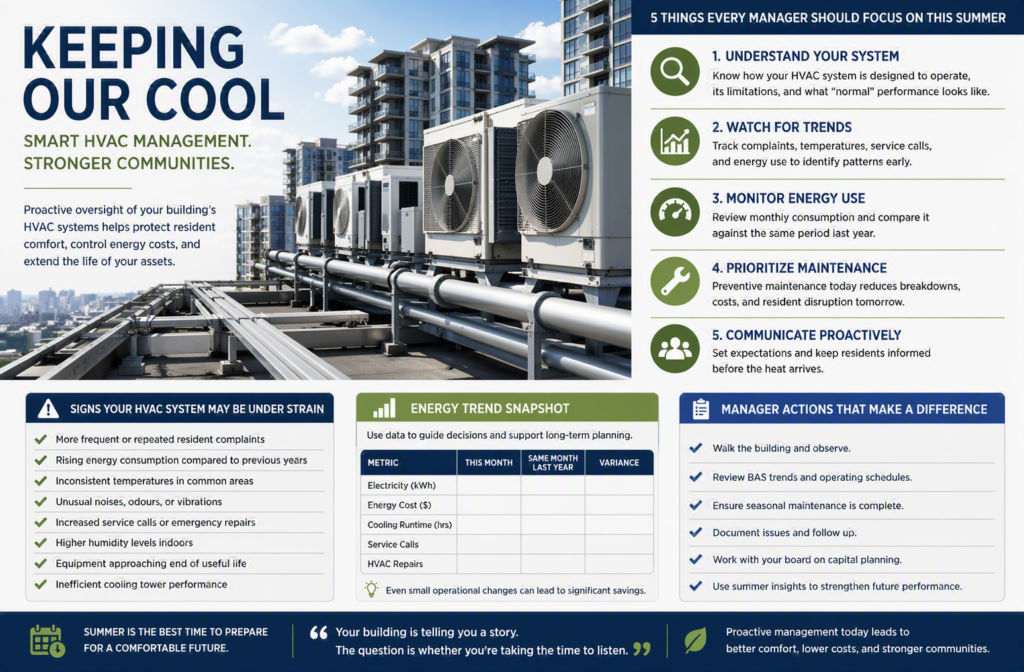
One of the most common mistakes I see is focusing on individual complaints rather than looking for broader trends. Every manager receives calls from residents who feel their suite is too warm or believe the air conditioning is not working properly. Sometimes the issue is isolated to a single unit. Other times, it signals something more significant.
When complaints start to increase, ask yourself:
- Are they coming from the same floor or stack?
- Are they occurring during specific times of the day?
- Have we seen similar concerns in previous years?
- Is there a common denominator?
Successful managers move beyond reacting to individual service requests and start looking for patterns. Trends provide valuable information. Complaints alone do not.
I have always believed that one of the most underrated tools in condominium management is simply walking the property.
During the summer months, take time to visit common areas throughout the day. Walk the corridors. Spend a few minutes in the fitness centre. Sit in the lobby. Visit the party room and mechanical spaces.
Your building will often tell you when something is changing long before a contractor’s report or resident complaint appears in your inbox.
A corridor feels warmer than usual. The lobby is struggling to maintain temperature during peak afternoon hours. These observations may seem small, but they often reveal opportunities to investigate issues before they become larger problems.
Another area that deserves greater attention is energy tracking.
Many condominium corporations review utility bills only when costs increase dramatically. Unfortunately, that approach is reactive and provides little insight into building performance.
Instead, managers and boards should focus on tracking energy trends over time.
A simple spreadsheet can provide valuable information by monitoring:
- Monthly electricity consumption
- Utility costs
- Average outdoor temperatures
- HVAC service calls
- Major mechanical repairs
- Equipment runtime data, where available
Over the course of a year, patterns begin to emerge.
For example, if energy consumption has steadily increased over several summers despite similar weather conditions, it may indicate aging equipment, operational inefficiencies, or systems that require recalibration. Having this information allows managers to provide meaningful recommendations to their boards and supports more informed budgeting and reserve fund decisions.
Preventative maintenance is another topic that often receives attention only when something goes wrong.
Cooling systems work hardest when residents need them most. Summer is not the time to discover that equipment has been operating inefficiently for months.
Managers should ensure that cooling towers, pumps, control systems, filters, and related equipment are being inspected and maintained according to schedule. More importantly, recurring issues should not be viewed as routine. If the same repairs are occurring season after season, it may be time to evaluate whether the corporation is addressing symptoms rather than the root cause.
In my experience, one of the most cost-effective strategies available to any condominium corporation is proactive communication.
Residents do not expect perfection. They do expect transparency.
A simple communication before a forecasted heat wave can help explain how the building’s cooling system operates, what residents can expect during periods of extreme heat, and how to report concerns. When residents understand what is happening and know management is actively monitoring conditions, frustration is often significantly reduced.
The greatest value of summer is that it exposes weaknesses we might not otherwise see.
Equipment that struggles during peak demand periods, increasing energy consumption, and recurring service calls are all providing useful information. These are not merely operational issues to manage; they are indicators that can help boards and managers make smarter decisions about future investments, reserve fund planning, and long-term asset management.
As condominium professionals, we spend much of our time solving immediate problems. Summer challenges us to do something more important: step back and look at the bigger picture.
Cooling systems, energy consumption, and HVAC performance are not just maintenance concerns. They are opportunities to better understand our buildings, improve operational efficiency, and strengthen the communities we serve.
This summer, I encourage managers and board members alike to look beyond the thermostat and beyond the monthly hydro bill. The real value lies in understanding the story your building is telling you and using that information to plan for the future.