
CAI Canada 2025 Summer Newsletter

President's Message
Starting the second half of the year, CAI Canada hosted our Annual General Meeting. We are pleased to announce the reappointment of Darla Ahmeti, Jake Fine, Mathew Arnoff and Sally Thomspon to the Board of Directors. We look forward to their continued contributions as we work together to shape the Ontario condominium landscape. The second half of the year also brings about a change in CAI Canada leadership, as I take over the reigns from Sally Thompson to serve as the new CAI Canada President. We offer our sincere gratitude to Sally for all that she has accomplished during her term. Sally has created strategic objectives which furthered the growth and presence of our Canadian Chapter. As I embark on my term as President I look forward to serving our members and enhancing our presence and contributions to the Canadian condominium sector.
Our annual conference took place in May with record attendance. We thank our sponsors, panelists moderators and event coordinators for their contributions, it certainly made for an educational and entertaining day.
Our advocacy committee has been reviewing amendments to the condominium act, and has now provided feedback to the Ministry. See details within this issue of the newsletter.
With economic changes effecting the real estate and construction industry, the coming months will be impactful to our industry at a large. We will continue to work in collaboration with industry experts to provide relevant content addressing the most pressing concerns.
Stay tuned for upcoming dates of both in person and online events.

Tanisha Jhuman, President
CAI Canada
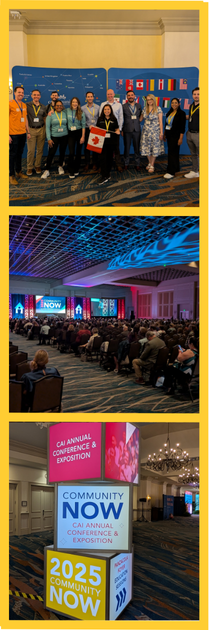
Recap: CAI Annual Conference & Exposition in Orlando, FL
Recently in May 2025, I had the chance to attend the CAI Annual Conference & Exposition: Community NOW, held in Orlando, Florida. This major event brought together over a thousand attendees—condominium managers, board members, service providers, and industry leaders—all focused on the future of community living.
The conference delivered a packed schedule of educational sessions covering governance, legal trends, technology, and innovation in the condo and HOA space. On the tradeshow floor, vendors showcased a wide range of tools and services shaping how communities are managed across North America.
It was also great to see a number of fellow Canadian vendors present, including Condo Control, Condo Voter, Minutes Solutions, and LeapAP along with my firm’s booth for Minutes On-Time. As a vendor, it was encouraging to see strong Canadian representation on the U.S. side and as Secretary of the Board for CAI Canada, it was valuable to experience the broader CAI network in action and see firsthand how service providers and communities are collaborating across borders.
– Tim Bolivar,
Secretary, CAI Canada & Founder, Minutes-On-Time
Why Condo Fees Keep Rising (Even When Inflation Doesn't)
Every condo board and property manager has heard it: “Why can’t we keep fees flat this year?” The reality? It’s rarely possible. While owners naturally want lower maintenance fees, unfortunately condo costs, like most things, tend to rise over time.
A trusted auditor once put it simply: if your home utility bill increases by 10%, you can’t just decide to pay 2% more. The same principle applies to condos. Most condo expenses are non-discretionary. If the cost goes up, fees need to follow.
To understand what’s really driving condo fee increases, in our annual report ‘Condo Fee Trends: 2024 Year in Review’, we analyzed anonymized budgets from 103 condo corporations across Toronto, Peel, York, and Halton. These buildings ranged from 1 to 52 years old and collectively managed over $230 million in condo fees. Here’s what we found.
Average Fee Increases Slowing (But Still Outpacing Inflation)
In 2024, condo fees increased by 3.3% on average, down from 5.1% in 2023 and nearly half of 2022’s pace. That’s the good news.
The not-so-good news? Consumer inflation hovered around 2% over the past year. So, condo fee increases still outpaced household inflation, but why?
Because condos have a completely different cost structure. Unlike consumer inflation, which tracks groceries and mortgage rates, condo budgets are driven by utilities, building repairs, and reserve fund contributions.
Reserve Fund Costs: The Biggest Pressure Point
Reserve fund contributions rose by 13% in 2024 – an acceleration from 11.8% the year before. That’s a big jump, especially since reserve fund allocations make up 26% of the average condo budget. A 13% increase on a quarter of your budget alone requires overall fees to rise by 3.4% to support that increase alone – so that’s before even accounting for other cost increases.
Why the spike? Replacement costs are soaring. Over the past five years, the Residential Building Construction Price Index rose 63.5%. Key items like concrete (+72%), steel framing (+66%), and window materials (+156%) have surged over that time frame.
Windows in particular are one of the most expensive long-term capital items for high-rise condos. Some buildings, allocate up to 40% of their lifecycle reserve fund
expenditures to future window replacement projects. Rising construction costs hit these budgets hard, and reserve fund studies will have to catch up.
Some Relief: Gas Prices and Insurance
There were a few bright spots. Gas costs in condo budgets fell by 9.0% in 2024, following dramatic spikes in 2022 and 2023. Looking ahead, proposed reductions to the carbon tax could bring further relief in the coming year.
Insurance costs also showed signs of stabilizing. After several years of sharp increases, 2024 marked the first average decline in premiums across our data set. This shift appears to be driven by a reduction in major claims and new insurers entering the condo market, helping to create a more competitive landscape.
Contract Services and Management Fees
Contract service costs (cleaning, concierge, elevator maintenance, etc.) rose by just 2.7% in 2024, in line with long-term wage growth trends. We expect this component to track general wage inflation going forward.
One area still seeing steady increases is management fees. They rose 3.6% in 2024, continuing a multi-year trend. The reason? A shortage of qualified property managers. Ontario has about 4,000 licensed managers for over 12,000 condo buildings – a 3:1 ratio. Recruitment, training, and retention costs are rising, and management firms seem to be passing those costs along.
Final Thoughts
It’s clear that many condo owners are feeling the pinch – whether from job uncertainty, rising mortgage payments, or years of stagnant wage growth. In this environment, condo fees are under more scrutiny than ever. While it’s unrealistic to expect fees to track perfectly with consumer inflation, what can be expected is transparency, thoughtful planning, and clear communication. A well-crafted budget isn’t just a financial document – it’s a chance for property managers and boards to build trust, demonstrate value, and show owners that every dollar is being spent with care. And in today’s climate, that kind of credibility is more important than ever.

Anthony Ing
Co-Founder of Condonexus
Building Automation Systems – Benefits That Go Beyond Savings

Fan Fong
Director Energy Management
Complete Energy Solutions
To meet the rising cost of utilities, condo boards across the country have taken measures to reduce consumption, invest in more efficient equipment, or install a building automation system (BAS) to ensure their mechanical equipment runs smarter, not harder. While many board treasurers are intrigued by the prospect of double-digit returns on investment, the benefits of a BAS go far beyond energy savings. For the rest of the board of directors—those focused on more than just numbers—a BAS offers several advantages that make it more than just a tool for cutting consumption. It can also improve resident comfort and resolve long-standing issues in older buildings.
Let’s start by answering the question: What is a building automation system (BAS), and why is everyone talking about it? Simply put, it’s the conductor of your building’s mechanical systems, including heating, ventilation, and air conditioning (HVAC), as well as the pumps associated with these systems. Control wires, sensors, and conduits connect this equipment to a series of controllers that can be programmed to improve operational efficiency and resident comfort.
In previous decades, BAS technology was mostly found in upscale office towers and hotels due to its expensive, proprietary hardware. However, the introduction of non-proprietary equipment and open-protocol standards has increased competition and driven down costs. These developments—paired with rising utility expenses have made BAS a financially attractive project that frequently delivers strong, consistent returns. But how is this possible? The answer lies in reduced utility consumption. A BAS is the strategic tool that helps stack the odds in the corporation’s favor.
One of the biggest challenges for property managers- becoming even more prominent due to climate change—is switching between heating and cooling, sometimes within the same week. Meeting resident needs can be difficult when changeovers must be scheduled weeks or even months in advance, especially when unpredictable weather flips the script. Instead of placing a service call or frustrating residents with news that the building has already changed over, buildings equipped with a BAS can switch building modes from heating to cooling remotely. This eliminates the need for costly and often delayed service calls during peak technician deployment periods.
Most BAS platforms, especially non-proprietary systems, allow for easy scheduling changes and one-click temporary overrides the settings. This can quickly bring down a building’s temperature—and its residents’ discomfort—when October decides to deliver a surprise heatwave. For many residents, the ability to access cooling on demand during off-season periods justifies the entire investment in a BAS.
When it comes to any piece of mechanical equipment, whether it be a car, a boiler, or a chiller, more mileage is generally going to lead to more repairs. By scheduling equipment to run only when needed or at a reduced speed, a BAS reduces both runtime and operational intensity, minimizing wear and tear.
This adds up over time and it especially matters when dealing with mechanical equipment like chillers, which are often the single most expensive piece of equipment in the building. For buildings that have recently retrofitted new equipment that has come off warranty, the goal is to ensure the equipment meets or exceeds its expected life span in the reserve fund study.
Using a BAS to ensure the equipment runs only as needed is one part of the equation, another aspect of BAS is ensuring that the operating conditions for the equipment are optimal. By assigning alarm states to a BAS, both critical and non-critical, the system can identify issues like short cycling, which could drastically reduce the life span of equipment if not addressed in a timely manner. Issues like low return temperatures in a heating system could also cause costly condensation damage in equipment not designed for this type of operation – with a BAS, these operational issues are reported immediately on a digital platform to building maintenance personnel, or the BAS monitoring company, who could then guide the problem towards resolution before the system incurs any significant damage. Viewed through this lens, a BAS serves as an extra layer of protection—like insurance. Avoiding just one major mechanical failure can more than cover the cost of the system.
The last and most compelling reason why many corporations are installing BAS is the return on investment (ROI). Utility companies, like Enbridge Gas, offer incentives and rebates that can cover up to 50%, and sometimes even 75% of the project cost, which often reduces project payback periods to three years or less. Using BAS to optimally schedule equipment results in less energy required to condition incoming fresh air, and less power required across the entire system to run pumps and motors. With utility costs consistently on the rise for the past several years, corporations who have installed BAS have seen increasing returns on investment or accelerated payback periods. In some cases, early adopters of BAS projects have seen the project pay for itself several times over, with no signs of disappointment. Is your building ready to smarten up? With the incentives currently available, now might be the perfect time to consider BAS.
Bridging the Experience Gap: Supporting New Entrants, Including Regulators
This year marks my 10th anniversary working in the condo industry. By many measures, that’s a lot. But at least in Ontario’s condominium market, 10 years barely scratches the surface.
This is an industry where true expertise develops slowly, and where the value of experience, and the cost of inexperience, can shape entire communities, whether it comes from a new board member, business partner, or regulator.
Most leaders I meet or have had the pleasure to work with have been in the condo industry for at least 25 years. From long-time condo board directors and property management professionals, to engineers, lawyers, restoration specialists, manufacturers, trades and other service providers.
Industry stakeholders seem to appreciate that expertise is developed over decades, not years (let alone months!). Properties have very long lifecycles, spanning well over 50+ years. The first condo in Ontario was registered in 1968, which means it only had its 57th anniversary. These days, that’s barely mid-life.
Board directors, managers and industry professionals gain their experience servicing condominiums over many years. Until a professional has worked with properties not only throughout all seasons in a year but also at all stages of the possible lifecycles, it’s difficult to appreciate all of the needs and situations they will encounter.
For this reason, professionals in the condo industry need to work together to support new organizations and professionals entering the market. It’s too easy to make mistakes when you first start out. During my first term as a board director, I wish someone had impressed on me the risk of underpaying a property management team, not spending enough on preventative maintenance, or not communicating enough with owners. I learned over time, but this took years.
The same is true with my condo project management software business. We knew we wanted to support board directors, but didn’t appreciate the number of tools and systems property managers were already using. We pivoted by focusing directly on reducing double entry and releasing time saving features for property managers. To be honest, it’s a constant work in progress and finding balance is difficult. I learn something new every day, working with leaders in the industry.
If condominium leaders don’t work together to support new entrants, over time know-how will be lost and too many mistakes will be made that could have been avoided. Condo owners, residents and the communities they live in, will ultimately suffer.
Condo Regulators are no Exception and Must be Equally Supported
Condominium regulatory and administrative organizations are equally new to the industry. The Condominium Management Regulatory Authority of Ontario (CMRAO), which regulates condominium managers, was only established in 2017. The Condominium Authority of Ontario (CAO), which is an administrative authority that provides information, education and dispute resolution to condo communities, was established in the same year, 2017.
In comparison to other professional regulatory and administrative organizations, such as the Law Society of Ontario (founded in 1797), the Ontario Human Rights Commission (founded 1961), and the Toronto Real Estate Board (founded in 1920), the CMRAO and CAO are very young organizations.
While the CMRAO and CAO try to draw from the experience of long-standing professionals in the condominium industry, as organizations, they have only experienced a handful of annual general meeting (AGM) cycles, budget cycles, reserve fund cycles, or let alone witnessed properties age over time.
It is normal for there to be growing pains in an industry as it adjusts to new regulators and administrative bodies. Regulatory organizations need to develop their processes, earn trust, gain experience in the industry, and establish quality resources and best practices for the stakeholders they regulate or administer. This takes time.
It’s Time to Build Bridges in the Condo Industry
Just as leaders in the condominium industry need to support new professionals and business organizations entering the market, new regulatory and administrative organizations need their support, too. Leaders and regulatory authorities should find more opportunities to collaborate on educational materials, policy consultations and joint industry events.
By working together in the condominium industry, volunteers, professionals, regulators and administrators can strengthen the communities we live in to improve the quality and affordability of condominium living, which should be our number one goal.

Salim Dharssi,
Managemate Founder
AI and Meeting Minutes: A Cautionary Conversation from the CAI Conferences

Tim Bolivar,
Founder of Minutes On-Time
At both the U.S. and Canadian CAI Annual Conferences this year, one of the most common questions I received was about artificial intelligence and its role in preparing meeting minutes. This topic comes up frequently. With AI tools gaining popularity, many are asking: Can artificial intelligence replace a human minute taker?
The short answer: it shouldn’t. Not if accuracy, legal reliability, and professionalism matter.
AI Is Inconsistent
One of the core problems with AI-generated minutes is inconsistency. From one meeting to the next, AI often produces a completely different style, length, and tone. In one case, the minutes may be overly detailed and conversational; in another, they might be so minimal that key context is lost. There’s no continuity, something that’s essential for building trust and maintaining clarity in a condo or HOA setting.
Boards rely on a predictable and professional format. When that changes meeting to meeting, it can confuse owners, directors, and property managers alike. Worse, it undermines confidence in the document as an official record.
AI Can Fabricate Information
This isn’t hypothetical; we’ve seen it happen! In one real meeting, AI generated a motion that never occurred. It inserted a full statement of approval on a topic that had been discussed, complete with a motioner and seconder from that meeting, when no motion had actually been made and no decision had been taken.
This is not just an error. It’s a fabrication.
When minutes record a motion that never happened, the liability risk becomes real. If those minutes are later relied upon by a board, a resident, or in legal proceedings, the consequences could be serious. Minutes must reflect the truth, not guesses, not assumptions, and definitely not AI-invented outcomes.
Legal Credibility Comes Into Question
Another concern we’re hearing more often: What happens if AI-produced minutes are ever challenged in court? If it becomes known that the official record was created by AI software, which cannot testify, be cross-examined, or explain its reasoning, the validity of those minutes isweakened. Judges and lawyers may reasonably question their credibility, especially if discrepancies arise.
Professional minute-taking services provide not only a record, but a human witness to the process. We follow standards, apply judgment, and ensure neutrality. If ever needed, we can explain exactly how a set of minutes was created and why something was or wasn’t included.
You Still Need Human Judgment
Boards often deal with nuances such as sensitive topics, informal consensus, confidentiality, or offhand remarks that shouldn’t be recorded verbatim. AI doesn’t understand any of that. It doesn’t know when a discussion is off the record, when to generalize wording to protect privacy, or how to frame a difficult topic diplomatically.
A professional minute taker makes these judgment calls every day. That’s part of what you’re paying for: not just typing, but the ability to accurately and fairly represent a meeting’s outcomes, in language that can stand the test of time and scrutiny.
Final Thoughts
AI is a powerful technology, but in the context of board and condo meetings, it introduces risk, not reliability. It’s not just about writing down what was said, it’s about understanding what matters, documenting it clearly, and producing a neutral, professional record that your community can trust.
If your association values credibility, consistency, and legal soundness, don’t hand over your minutes to a machine. Trust a professional—someone who knows the process, knows the stakes, and shows up to get it right.
Join Our Newsletter